Lead Children to Heaven!
Encourage the children entrusted to your care to embrace the devotion of the First Fridays and lead them toward Jesus’ promise—a promise that strengthens hearts and leads to Heaven.

Lead Children to Heaven!
Encourage the children entrusted to your care to embrace the devotion of the First Fridays and lead them toward Jesus’ promise—a promise that strengthens hearts and leads to Heaven.
Why Has HEART9 Become So Popular Among Children?
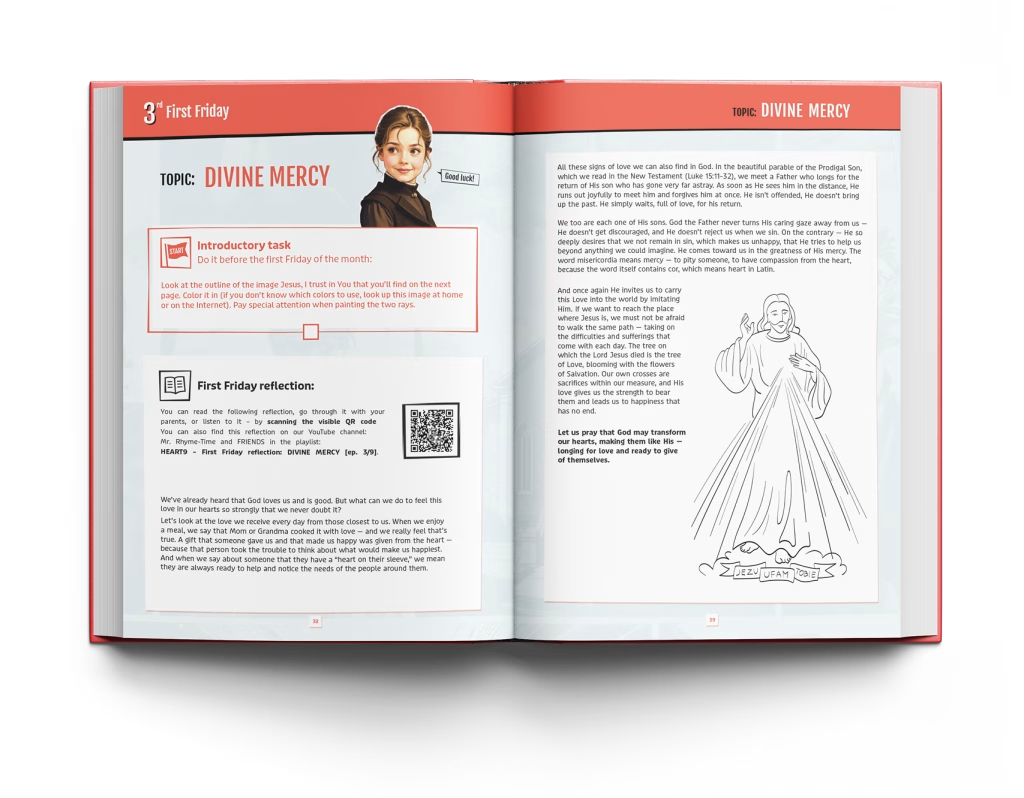
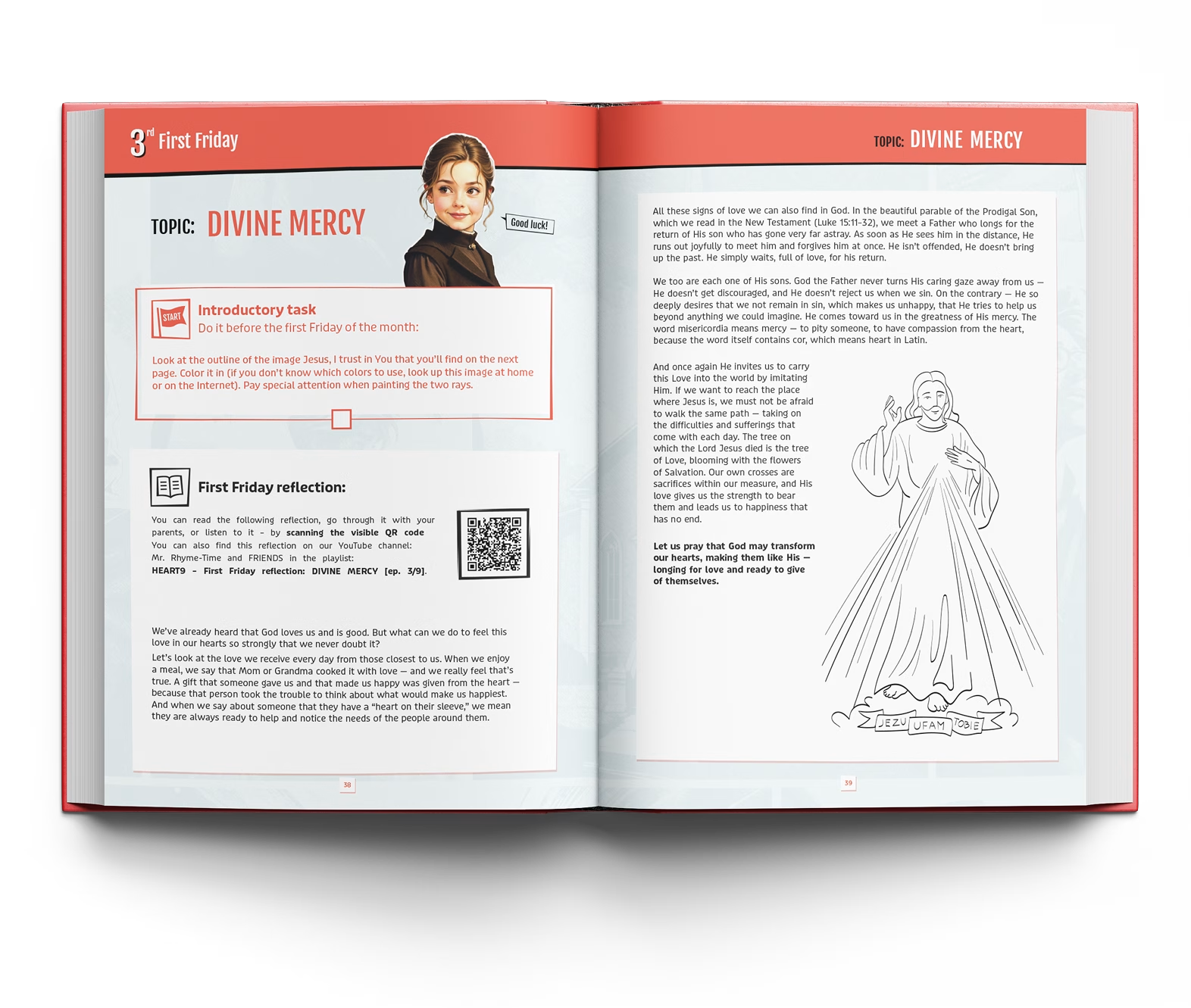
HEART9 is a practical resource for priests, catechists, and leaders of parish groups that helps guide children through the devotion of the Nine First Fridays in a simple and engaging way.
It contains ready-to-use materials, short catecheses, and practical activities that make it easy to connect the truths of faith with the everyday lives of young people.
It helps participants, step by step, prepare for Confession, the Eucharist, and the building of a personal relationship with Jesus—here and now. It is a proven pastoral resource, recommended by bishops.

25 thousand copies sold in 8 months

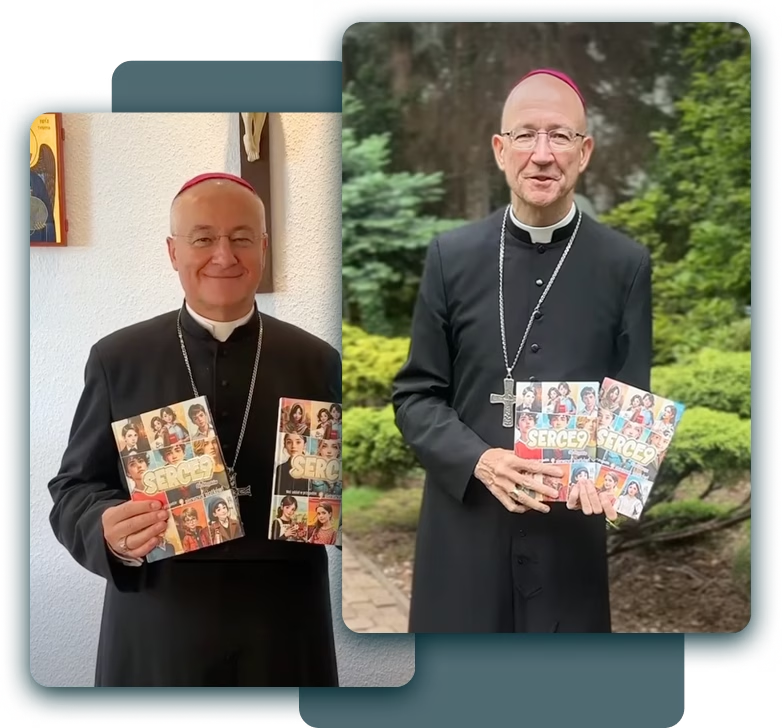
Recommended by bishops

19 musical hits for the whole family

28 QR codes with audio materials

27 practical challenges to complete
,,I would like to draw your attention to this proposal. Heart9 is something we have known for a long time, but renewed, revitalized, and presented in a good educational form. I recommend it.”
Archbishop Adrian Józef Galbas SAC

,,For the first time in my life, I was moved to tears with delight over a book. I wholeheartedly recommend it to priests and parents!”
Fr. Zbigniew Ptak OSPPE
,,As a parish priest, I was searching for materials like this. Now I have finally found a beautiful resource and a beautiful method, which I recommend to pastors, parents, and to children themselves.”
Bishop Artur Ważny
How Can We Wisely Accompany a Child During the Devotion? FAQ
Always with ourselves. Children always observe very carefully the people who introduce them to the teachings of Jesus Christ. That is why our own witness of faith in everyday life is so important. It is this witness that builds credibility and offers an alternative to the values promoted by this world.
How can such a witness of faith be expressed?
- In prayer – through our quiet witness of persevering in humble prayer before God, through genuinely falling in love with Him and being moved by His presence in our
- In apologizing and making amends for our own faults, and in being ready, after the example of Christ, to forgive every single time.
- In being willing to serve God and our neighbor—even when we are tired, worried, or when life is truly difficult.
- In striving for holiness, even though we are not perfect.
Children do see the sins committed by people in the Church. Yet through our witness they can see that we cooperate with God’s grace and that even when we fall, we are able to rise again. They can observe that even amid difficulties we do not lose hope or trust, but continue faithfully following Jesus.
The essential element is, of course, participation in the Eucharist on the First Friday of the month and receiving Holy Communion in reparation to the Sacred Heart of Jesus. This is the essence of the devotion. This should always be emphasized. In many places, children leave the church after so-called First Friday confession and do not remain for Holy Mass. As a supplement, we offer materials and activities—some are available online, while others are included in the book. Their purpose is to help children experience the devotion more consciously and with greater involvement of the heart. Of course, this does not mean that every activity has to be completed. During one year, one or two additional activities each month may be enough, while in another year different activities can be chosen. It is always better to encourage greater involvement rather than verify who completed every task.
The First Fridays devotion is already widely practiced in parishes. It may be worthwhile to organize a separate Holy Mass for children with a homily prepared specifically for them. It also seems important to organize confession so that there is a longer opportunity for confession on one of the days preceding the First Friday. If we wish to enter more deeply into the devotion at the parish or community level, it is worthwhile to connect additional activities with the Holy Mass celebrated that day. These activities may take place either before or after Mass. Another valuable option is to organize them on the Saturday or Sunday before or after the First Friday, in a space designated for parish or community gatherings. In our materials, we provide concrete ideas and suggestions for how such meetings may be conducted.
Conversations with children during homilies or meetings will certainly be very important. This will not only be an opportunity to ask them how they understand the reflections or how they are managing the activities and tasks. It is also a chance to listen and discover how they experience these teachings and the devotion itself. It is worthwhile for the person responsible for children’s formation in the parish or community to take the initiative to unite and involve other adults in activities related to preparing for and celebrating the devotion. Organizing a meeting for parents before the devotion begins may prove very beneficial. It would provide an opportunity to invite them to cooperate, help organize additional activities, and actively participate in the devotion itself. The involvement of even a few people who could take over some of the responsibilities related to preparing and beautifully celebrating the devotion—not only for children—may become invaluable help in everyday life, which is already filled with many obligations.
Of course, despite our sincere efforts, there may be times when we are unable to answer every question that arises during the devotion or solve every problem that may appear. Do not be afraid to admit that you do not know something. Very often, simply having a conversation and allowing children to feel heard can help them look at a difficulty from a completely different perspective or dispel their doubts. Honesty in a relationship does not undermine your authority—pretending and lacking authenticity certainly can. Showing children that you do not know everything either, but that you continue searching and striving to grow in virtue, will be a valuable testio=mony and an encouragement for them to imitate. Have the courage to keep searching—to ask questions and seek advice from those around you: in your parish, among friends, and within your community.
This may sound simple, but… it is actually good news. It means that you are not simply checking off prayers and tasks, but are striving to experience this devotion consciously and deeply. And this is an essential condition for living out the devotion as Jesus desires. Therefore, rejoice that you notice these difficulties—they are always an opportunity to seek something greater. We trust that in these materials you will find the guidance you need. Do not give up too easily!
Do not treat a decline in motivation or a lack of interest in the devotion as a clear sign of your own mistakes or of the program being unsuited to the needs of the group. There may be many other reasons related to children’s social and emotional lives. These include media overstimulation, difficulties with concentration and focus, an inability to embrace silence, and a crisis of relationships. And after all, how often do we ourselves, as adults, experience crises in our prayer life and in remaining faithful to our commitments?
Certainly not. Avoid all-or-nothing thinking (the attitude that says: “If everyone is not delighted, then this effort is pointless.”). Our task is to sow, not to gather the harvest. Even the Sower sows where, from a human perspective, there seems to be no chance of growth. We will not always see the fruits of our work—they may appear much, much later. And sometimes it may be about that one sheep for whom the Lord is fighting in a special way, making use of our gifts and our efforts. For that one child, it is always worth it.
Fortunately, there can be many different ideas here. Here are a few suggestions:
- Reminding children about the devotion—its meaning and purpose—through parish announcements.
- A brief invitation or encouragement during the homily, focusing on one of the suggested activities or tasks for that particular month.
- Showing, as a priest, catechist, or group leader, that you also practice this devotion and take it seriously.
- We can complete the same activities and tasks that we propose to children and, in conversations, share our own experiences, difficulties, and successes in living out the devotion.
- Drawing lots for a statue of the Sacred Heart of Jesus to be entrusted to one family each month.
- Children who fulfill the two essential conditions of the First Friday devotion may place a slip of paper with their name into the drawing.
- Organizing an exhibition of children’s artwork within the parish or school.
In the supplementary materials, we also provide additional ideas on how devotional practices connected with this devotion can be expanded within a parish or community in engaging ways, while harmoniously integrating them with the rhythm of the liturgical year.
Lesson Plans and Ideas for Working with Children
Opening activity: I invite everyone who…
Participants sit in a circle. The game is led by the person who has an empty chair on their right. That person says: “I invite everyone who…” and adds a characteristic, for example: ate cheese for breakfast, were born before noon, like… etc. The first person to sit in the empty chair wins that round. The game continues with the person who now has an empty chair on their right.
Catechesis
- A presentation about the color red – what things around us are red?
- We point to blood and to the heart.
- A discussion about the heart – why it is important and what it is needed for.
- We finish with the Heart of Jesus – why is it so special?
Craft activity
Crepe-paper rose
Closing activity: paper race
The participants each receive two sheets of paper. They stand on one sheet at the starting line and hold the other in their hand. To move forward, they must place one sheet in front of them (right next to the other sheet) and then pick up the sheet they were just standing on. This is repeated until they reach the finish line.
Opening activity: learning each other’s names
Participants sit in a circle. One person stands in the center holding a rolled-up sheet of paper or crepe paper (it should be fairly soft). The players call out the names of other participants (if two people have the same name, use a nickname or diminutive form). If the person in the center manages to tap the called person’s knee with the “baton” before that person names someone else, they switch places. A switch also takes place if someone calls the name of a person who is not present or the person standing in the center.
Catechesis
- Begin the presentation with a red traffic light and a STOP sign.
- Refer to Eve’s temptation in the Garden of Eden and to sin, which leaves stains behind.
- Together we reflect on what we should avoid and what direction we should follow. Connect this to the Ten Commandments.
- How can stains be removed? Explain the role of Baptism and the Sacrament of Reconciliation.
Craft activity
Examination of Conscience Notebook
Closing activity: memory game
Two players leave the room. The remaining participants form pairs, making sure the pairs are not obvious to those who left, and each pair agrees on a unique identifying gesture or signal. The leader checks that every pair has a different signal. The group stands in a circle, the two players return, and they play a live version of the memory game.
Opening activity: pictures on backs
The first person looks at a picture and draws it with a finger on the back of the next person. Each participant passes on the drawing they “received” on their back. The last person draws it on paper. Then the drawings are compared.
Catechesis
- Together we look at the image “Jesus, I Trust in You” – what do we notice in it?
- We explain the different elements of the image.
- Through this image, what is Jesus especially inviting me to today?
- How can I respond to His love with my life?
Craft activity
A stained-glass version of the “Jesus, I Trust in You” image made on tracing paper with tissue paper OR a small shrine made from the top section of an egg carton.
Closing activity: Christmas tree bowling
Players bowl as in a traditional bowling game, but as a group activity. The group has a Christmas tree drawn on a large sheet of paper, with numbers from 1 to 9 (or as many numbers as there are bowling pins, though no more than 10 is recommended). Participants take turns rolling the ball, not to knock down as many pins as possible, but to identify one specific number. The group wins when all the numbers on the Christmas tree have been crossed off.
Opening activity: shadows
Participants sit in a circle and close their eyes. Three people become “shadows” and move quietly behind the chairs of the seated participants. Each shadow chooses one person and stands behind them. When all the shadows are in place, the leader asks those who think a shadow is standing behind them to raise their hand. Then everyone opens their eyes and checks how well they identified the shadows.
Catechesis
- A presentation on the meaning of the Eucharist – the sacrifices of the Old Testament and the sacrifice of the new and eternal covenant
- What happens at every Holy Mass? A discussion about Eucharistic miracles.
- How do we behave at Mass, and are we able to pay attention? Is Mass truly important to us?
- Do we understand our role at Mass?
Craft activity
Fruit salad (prepared and eaten together)
Closing activity: water / juice / cocoa / lemonade
Place a line on the floor. Participants stand one behind another with the line between their feet. This position represents “juice.” When the leader calls “water,” participants jump with both feet to the left side of the line. When the leader calls “cocoa,” they jump to the right side. When the leader calls “lemonade,” participants turn around 180 degrees and continue the game with the directions reversed.
Opening activity: Taboo
Divide the participants into two teams. One person gives verbal clues to their team (following the rules of Taboo) so that they can guess a keyword. The clue-giver may not use either the keyword itself or the listed forbidden words.
Catechesis
- How does God come to us? In an earthquake, a mighty wind, fire, or in the gentle whisper of a quiet breeze?
- When does the Holy Spirit come to us in a special way?
- What gifts do we receive from the Holy Spirit? Why are they so different from the usual gifts we receive?
- What fruits can our lives bear when we cooperate with the grace of the Holy Spirit?
Craft activity
Fruit salad (prepared and eaten together)
Closing activity: Famous Characters
Participants move around freely. The leader introduces different characters (Viking, mummy, monk, knight, archer, hunter, scuba diver, driver, etc.) and demonstrates how to imitate them. Anyone who makes a mistake must continue acting as the character at which they made the mistake.
Opening activity: artistic teamwork
The group sits around a table. Everyone begins drawing a picture on the sheet of paper in front of them. When the leader calls “change,” participants move one seat to the right and continue drawing someone else’s picture. The activity continues until everyone returns to their original seat. Each participant may be given a different color crayon, although this is not necessary. The same idea can also be used to create a story: each person writes one sentence and then moves to the next seat.
Catechesis
- Presentation – when do we write “church” with a lowercase letter and when with a capital letter, and what determines the difference (perhaps the size of the church building…?)
- Why are buildings not the most important thing, and what is the real difference?
- The community as a treasure of the Church
- To bring peace, it is important to begin with ourselves (a resolution to improve and making amends to God and to our neighbor)
Craft activity
A mug for someone special (decorated with drawings made using ceramic markers)
Closing activity: I keep on the ground…
Played in pairs or groups of three. The leader gives instructions such as: “Two feet and one hand must remain on the ground.” The teams must work together to complete each challenge according to the instruction.
Opening activity: Peek-Peek, an Easter version of “Bang-Bang”
The leader points to one person in the circle and says “peek.” That person must immediately crouch down. The two people standing closest to that person (on the left and right) point toward each other and say “peek.” The person who reacts too slowly (either by crouching or by making the “shot”) is eliminated.
Catechesis
- Mary – the New Eve – without sin
- The union of the Hearts of Mary and Jesus (Mary as the first tabernacle)
- The Mother of Jesus as the one who never doubted – carrying the Church through the three days from Calvary to the Resurrection
- To know and love the Heart of Jesus, we must learn from Mary – she is also our mother and teacher
Craft activity
A decorative flower vase made from a chips container or a plastic bottle
Closing activity: Egg–Chicken Soup
At the start of the game, everyone is an egg (represented by a body pose). In pairs, participants play Rock–Paper–Scissors. The winner becomes a chick and looks for another chick to challenge. The next stages (each achieved by defeating someone of the same stage) are hen and rooster. The winner of the rooster match becomes chicken soup and stands to the side.
Opening activity: Charades – What Country Is It?
The leader acts out gestures associated with a particular country (for example: bullfighting – Spain; eating frogs and snails – France; a characteristic dance – Egypt…). The group’s task is to guess which country is being represented. Later, participants can take turns acting out other clues.
Catechesis
- A quiz on recognizing national flags – ending with the flags of Poland and France
- A quiz about Saint Margaret Mary Alacoque and Saint Faustina Kowalska – how were they different, and what did they have in common?
- Presenting the shared mission of these saints: encouraging devotion to the Sacred Heart of Jesus
- An invitation for each of us to join this mission, through which we can obtain many graces for the world and for sinners
Craft activity
A photo or picture frame OR a decorative picture stand made from a pool noodle
Closing activity: Disappearing Name Squares
Place sheets of paper on the floor – one fewer than the number of participants. The participants walk freely among the sheets while the leader calls out different names. The goal is to stand on a sheet as quickly as possible whenever the leader says the name “Margaret” or “Faustina.”
Opening activity: conductor
One person leaves the group. The remaining participants choose a conductor – the person who changes the melody and the instruments (all represented through gestures and voice sounds). The person who left returns as the detective and must figure out who the conductor is. The group tries not to look directly at the conductor so as not to make the detective’s task easier, and the conductor avoids making sudden changes.
Catechesis
- Who knows us best? Who truly knows what we need and what is good for us? Our parents? Our friends? Ourselves? Or perhaps God?
- If He knows us so well, perhaps it is worth listening to Him?
- And how well do we know God? Do we spend time with Him? Do we treat meeting Him as something truly important?
- Adoration of the Blessed Sacrament, so that we can spend time with Jesus, come to know Him, hear the words He speaks to us, experience His love, and prepare a dwelling place for His Heart within our own hearts
Craft activity
Heart on a board – small nails hammered into a heart shape, with red string woven between them many times in different directions to fill the center with red
Closing activity: wilderness
Participants stand in a circle. The leader stands in the middle and points to different people while calling out the names of animals (elephant, giraffe, monkey, kangaroo, crocodile, lion, snake, etc.) that can be found in the wilderness. The selected person and the neighbors on both sides must quickly form the correct pose. Anyone who makes a mistake swaps places with the leader.
Ideas for Expanding Devotional Practices in the Parish / Community / School
An invitation to Mary, on this First Friday, to accompany us as we practice this devotion and teach us love for the Sacred Heart of Jesus – combined with the Rosary devotion.
Recite or sing together the Litany of All Saints.
An Advent vigil with Mary (Advent hymns) – for example, you can listen to or sing the Akathist to the Mother of God. https://www.youtube.com/watch?v=K2IYzQ2Ava4&list=RDK2IYzQ2Ava4&start_radio=1
Family Christmas caroling after Holy Mass on the First Friday, or on Saturday/Sunday afternoon.
A family carnival evening with games, activities, and board games (in the parish hall).
Stations of the Cross inspired by reflections on the love of the Sacred Heart of Jesus.
Suggested resources:
Reflections for adults: https://mycatholic.life/catholic-prayers/stations-of-the-cross/
Reflections for children: https://dmsbcatholic.com/wp-content/uploads/2024/10/Childrens-Stations-of-the-Cross-for-Coloring-1.pdf
Adoration (for example, at the Lord’s Tomb or before the Cross). If the First Friday of April falls after Easter, hold an adoration service with songs of praise, rejoicing in the joy of the Resurrection.
May Crowning (find a Mary’s shrine in your neighborhood)
A festive Holy Mass and a family parish festival (combining the final First Friday with graduation season).
Downloads

What is the devotion of the First Fridays about?
The devotion of the First Fridays is a response to Jesus’ invitation. He desires that for 9 consecutive First Fridays of the month we receive Holy Communion and learn to love as He loves, drawing ever closer to His Heart. It is a beautiful path that helps us live well here and now – to love, to forgive, and to trust God every day. This devotion is also connected with a promise from Jesus:
“The all-powerful love of My Heart will grant to all those who receive Holy Communion on the First Friday of nine consecutive months the grace of final repentance, so that they will not die in My displeasure nor without the sacraments; and My Heart will be their safe refuge in the hour of death.”
Action Plan:

step 1.
Get the ebook by clicking the link

step 2.
Take part in Holy Mass and receive Holy Communion on every First Friday of the month (x9)

step 3.
Take on the challenges suggested in the book
What will you find inside the book?
- 9 reflections about the Most Sacred Heart of Jesus
- 19 musical hits for the whole family
- 28 QR codes with audio materials
- 16 beautiful portraits of holy boys and girls
- 27 practical challenges to complete
- 18 interesting facts and a practical examination of conscience
“It is the world’s first interactive and comprehensive pastoral tool that helps children experience this devotion deeply.”